In the world of venous surgery, we are often taught a simple rule: “If a vein refluxes, close it.” This logic works fine for a single leaking pipe.
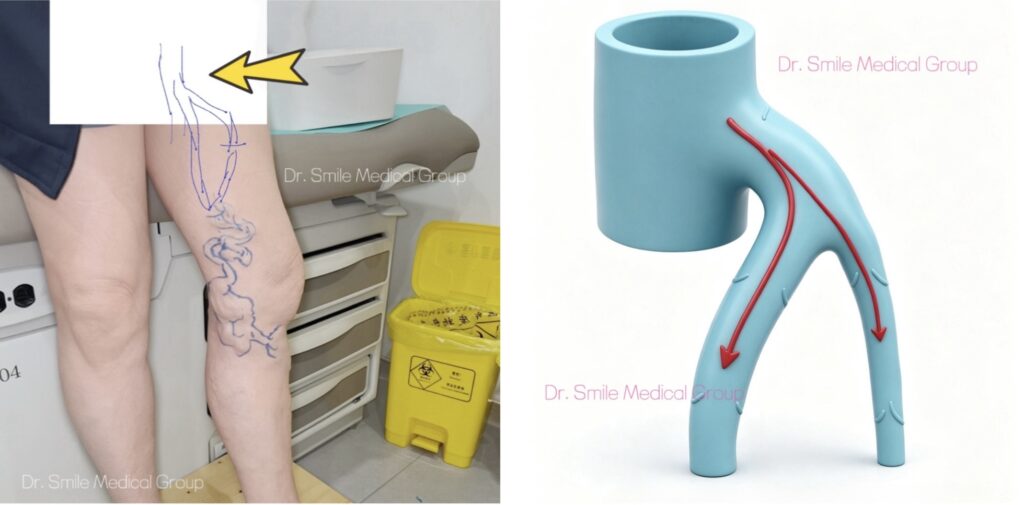
But what happens when you face Dual-Channel Reflux—where both the Great Saphenous Vein (GSV) and the Anterior Accessory Saphenous Vein (AASV) are failing together?
Most surgeons simply perform a “double ablation,” sealing both channels with heat. But from a hemodynamic perspective, this is like trying to fix a flooded city by filling all the drainage pipes with concrete. Here is why we need a more intelligent approach.
The “Dead End” Problem: Don’t Block the Exit
Every varicose vein system has an RP (Re-entry Point)—think of it as a “drainage exit” where blood finally finds its way back into the deep veins.
- The Problem with Ablation: When we use lasers or radiofrequency to seal the GSV and AASV, we aren’t just stopping the leak. We are also destroying the exits (the RPs).
- The Result: The superficial system is turned into a dead-end street. If even a tiny amount of pressure returns later, there’s no place for the blood to go. This “trapped pressure” is exactly what causes high recurrence rates in complex cases.
CHIVA: Changing the Flow, Not Removing the Pipe
CHIVA doesn’t ask, “Which vein can we kill?” It asks, “How can we fix the traffic flow?”
Instead of burning the vessels, CHIVA uses a precise “disconnect” at the source (the Escape Point).
- By cutting off the high-pressure source but leaving the vessels intact, we transform those “leaking pipes” back into “drainage pipes.”
- Because we keep the RPs (the exits) open, the blood can naturally flow back into the deep system. We solve the pressure problem without destroying the anatomy.
AASV: A Fragile Target for Heat
The AASV is notoriously difficult for thermal ablation. It sits very close to the skin and often follows a zig-zag path.
- Using high heat here often leads to skin burns, nerve irritation, or painful “lumps” (induration).
- The CHIVA Advantage: Since we don’t need to thread a laser fiber through every inch of the AASV, we avoid these “collateral damages” entirely. We treat the cause, not the geometry.
4. Saving the “Spare Parts”
We must never forget that the GSV is the body’s best “spare part” for future heart bypass or arterial surgery. Sealing both the GSV and AASV in one go is like throwing away your insurance policy.
The Bottom Line: Surgery with Restraint
The future of vascular surgery isn’t about who has the strongest laser; it’s about who understands the blood flow best.
For dual-channel reflux, the goal shouldn’t be “Total Closure.” It should be “Total Rebalancing.” By preserving the vessels and their drainage exits (RPs), CHIVA offers a more elegant, safer, and more “human” way to treat varicose veins.