
The Cost of Losing the Great Saphenous Vein in Post-Thrombotic Limbs

0
9
Impact of great saphenous vein ablation on healing and recurrence of venous leg ulcers in patients with post-thrombotic syndrome: A retrospective comparative study.

A recent study in the Journal of Vascular Surgery: Venous and Lymphatic Disorders highlights an important clinical reality:

In patients with post-thrombotic syndrome (PTS), the presence of the Great Saphenous Vein (GSV) may significantly influence ulcer healing and long-term outcomes.

Traditionally, a refluxing GSV is considered pathological and often treated accordingly. However, this assumption becomes questionable when venous hemodynamics are altered.

When deep venous outflow is compromised after thrombosis, the GSV may no longer function simply as a source of reflux. It may serve as a compensatory outflow pathway, helping maintain venous return.
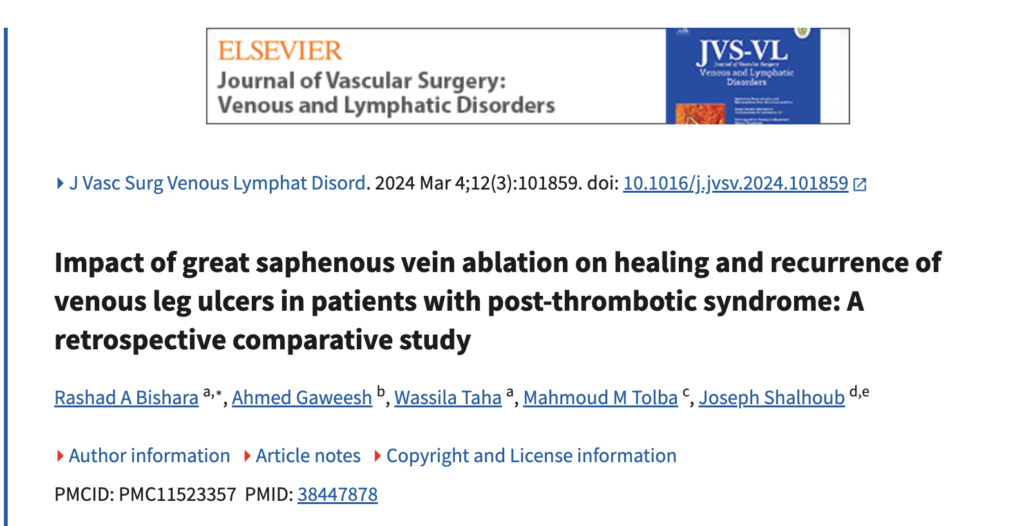
Impact of great saphenous vein ablation on healing and recurrence of venous leg ulcers in patients with post-thrombotic syndrome: A retrospective comparative study.

The study by Bishara et al. compared PTS patients with active venous ulcers (CEAP C6) and found:

  • Healing rate: 97% with preserved GSV vs 71% without
  • Median healing time: 42.5 vs 161 days
  • Recurrence/non-healing: 27% vs 85%

Notably, these differences persisted even when the GSV was refluxing—as long as it remained patent.

This suggests a key point: Functional contribution may be more important than structural perfection.

From a clinical perspective, this challenges a familiar approach.

The decision to treat the GSV should not rely solely on the presence of reflux.
A more relevant question is:

Does this vein still contribute to venous return?

If so, its removal may reduce the system’s ability to adapt—particularly in a limb already compromised by PTS.

PTS is a progressive condition. Future deterioration or recurrent thrombosis is always possible. In this context, preserving venous pathways is not only about current outcomes, but also about future reserve.

Once the GSV is removed, that reserve is lost.

Commentary

This study reinforces a broader shift in venous surgery:

From eliminating abnormal veins to understanding and preserving functional pathways

At the time of intervention, we are not only treating the present—we are shaping the patient’s long-term capacity to respond to disease.

Previous articleWhy CHIVA is the Smarter Choice for Dual-Channel Reflux (GSV + AASV)
Next articleWhy CHIVA is the Safer Choice for Small Saphenous Vein Reflux: A Focus on Nerve Preservation
Dr. Qiang Zhang
Dr. Qiang Zhang is a vascular surgeon with more than three decades of clinical experience in the treatment of venous disease. His work focuses on the hemodynamic understanding of varicose veins and the development of vein-preserving treatment strategies, including the CHIVA method. Over the course of his career, Dr. Zhang and his team have treated more than 100,000 patients with varicose veins, contributing extensive clinical experience to the field of venous medicine. Dr. Zhang is the founder of Dr. Smile Medical Group, a network of vein centers dedicated to the treatment of chronic venous disease. Through clinical practice and physician education, the organization promotes approaches that aim to preserve the physiological function of the venous system while addressing venous insufficiency. He is also the initiator of the Global CHIVA Center Program, an international initiative that supports physician training, clinical collaboration, and the development of CHIVA-based vein centers. Dr. Zhang serves as Executive Chairman of the Asian Venous Academy, promoting academic exchange and professional education in venous medicine across Asia. His work is guided by a fundamental principle: the treatment of varicose veins should respect venous hemodynamics and preserve the natural function of the venous system. Rather than simply eliminating diseased veins, he advocates approaches that restore physiological circulation and maintain the integrity of the venous network whenever possible.

LEAVE A REPLY

Please enter your comment!
Please enter your name here